3/3/22

Time Traveling: Goldwell Open Air Museum, Beatty, Nevada

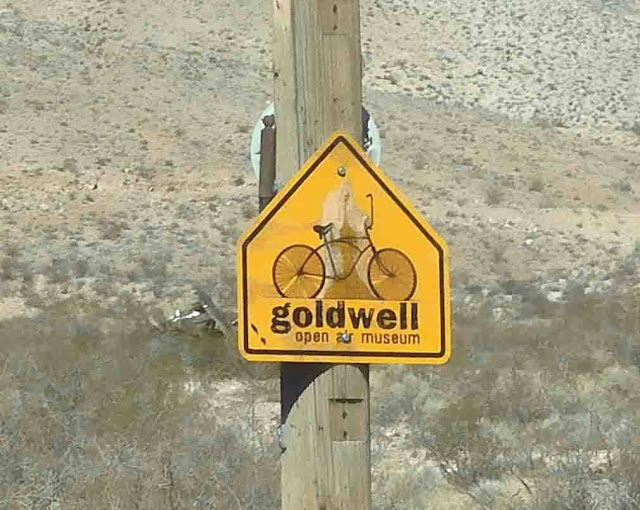
Good morning, virtual fellow travelers. For today's time traveling, let's back up about a week to our visit to the Goldwell Open Air Museum near Beatty, Nevada. The "museum" is located just outside Death Valley National Park, and close to the small town of Beatty. As we left the park, we found the usual throng of visitors climbing the sign and messing up my pictures. Honestly, the nerve of some people. 


Leaving the park, it's only a few yards more before crossing into the state of Nevada. During our visit to Death Valley, we crossed the border about half a dozen times in our sight-seeing adventures.


We were hoping to see some wild burros, but saw none on this trip.


As we headed toward the museum, we noted some mining activity off in the distance. As we approached, I realized we were headed right there. The collection of structures in the image below is the open air museum . . .


and the ghost town of Rhyolite.


Just prior to reaching Rhyolite, the museum appears. 


And what a weird place this is! It's been about 15 years since our first visit to Rhyolite, and I don't remember any of this stuff, although...according to their literature...it should have been there then. The first sculpture we encountered was the Ghost Rider created by Belgian artist Albert Szukalski. Ask me no questions, I'll give you no answers...because, frankly, I have no answers for what I'm about to show you.


I learned about this place from a random Facebook post, and we figured we'd come take a look. What an eclectic collection of stuff. This next image shows a "Tribute to Shorty Harris," a legendary prospector in Rhyolite. His hopeful companion, a penguin, represents the artist who always felt out of place in the desert.


Moving on, the work known as "Sit Here!" created by artist Sofie Siegmann. It was originally created as an artist-in-residence project for a museum in Las Vegas. The couch was rescued, relocated, and rehabilitated at Goldwell in 2007.


I walked around, taking pictures from different angles.


Anyone feel inspired to make a quilt from this?


In the image below, I was trying to take a fractured selfie, but it didn't work very well.


Here...a collection of cairns. And...why???


Moving on we saw "1000 in 1 Cranes." It was created by artist Cierra Pedro. The 1,000 in its name refers to the 1,000 small paper cranes that are strung together in a "senbazuru," a traditional gift at weddings and sometimes newborn babies. Here's a picture of one from Wikipedia:


The size of the metal crane is calculated to roughly equal the total size of the 1,000 paper cranes, so it is 1,000 in 1.


Beyond, you can see "Lady Desert: The Venus of Nevada." Dr. Hugo Heyerman was the artist, and it refers back to classical Greek sculpture while maintaining a pixelated presence in the high-tech world of the 21st Century.


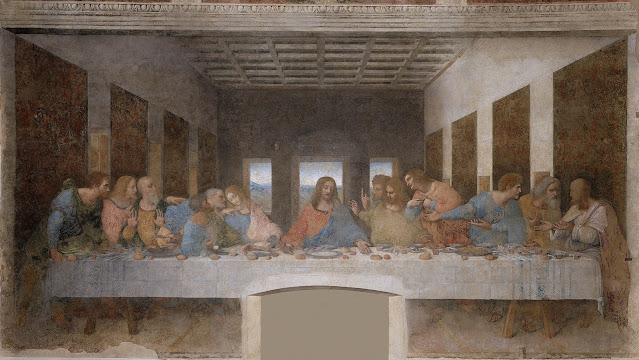
But this is what we really came to see. It is a major sculpture by Albert Szukalski, titled "The Last Supper." It is a ghostly interpretation of Christ and his disciples sited against the backdrop of the expansive Amargosa Valley. 


I moved from right to left taking pictures of the individual pieces. 


To make these life-sized ghost figures, the artist wrapped live models in fabric soaked in wet plaster and posed them as in the painting by Leonardo Da Vinci


When the plaster set, the model was slipped out, leaving the rigid shroud that surrounded him/her. With more refining, the artist then coated the figures with fiberglass making them impervious to weather.


In subsequent years, six additional pieces were added to the site by three other Belgian artists who were also major figures in European art with extensive exhibition records, but who chose to create in relative obscurity in the Nevada desert.


This next one is known as the "Serving Ghost," and it was a private commission donated to the museum by Art & Patricia Adams. Originally, the ghost was serving from a set of vertical wooden bottles that eventually disintegrated. The low profile artist's palette was more recently added.


Okay...so that was interesting. Also seen: these concentric circles of rocks.


These next two images are the front and back of "Icara," created by artist Dre Peeters. It represents a female counterpoint to the Greek myth of Icarus, the boy who tried to fly to the sun with wings bound in wax. The figure was hand-carved right here on site.


I'm showing you on the map in this next image the areas we explored on this trip. The red arrow marks the Leadfield ghost town. The blue "X" marks where the open air museum is. Looking farther down the map, you can see where the Furnace Creek Visitor Center is, and the campground where we stayed is marked with a red "X".


And, just for grins, I wanted you to see the remote area where the museum is located. Look below, and see nothing all around.


As we left, I took some pictures of these power poles decorated with all sorts of stuff. I believe that's a horn from a longhorn sheep.


Below, the sign for the museum gift shop was just lying on the ground. The "gift shop" was open, but there was nothing for sale aside from some framed photographs.


From there, we headed into Beatty for some lunch. Along the way, we saw this sculpture of a prospector and his mule.


What follows are some leftover images of Death Valley. There weren't many blooming things in our travels, but I always love seeing the bougainvillea in Furnace Creek. It's one of the things I miss most about my home state of California.


Also, some pretty potted geraniums.


The restaurants and inns in Death Valley were taken over by a private vendor some years back. A lot of work has been done sprucing up all of the buildings. Here's a plaque explaining the history of Furnace Creek Ranch.


The whole area has been under construction during the past couple of years, but it appears close to being finished. We just wandered around looking at the new structures. Here, there was a demonstration set up for chipping flint to make arrow heads. The largest of the ones shown here were about 6 inches in length.


I was happy they'd left some of the biggest trees despite building new structures all around. There isn't much shade in Furnace Creek, and these trees were very nice.


There was a van parked nearby. I liked this drawing of the woman on a bicycle. I had a mind to try it as a quilting motif sometime. And, you know...this is exactly how I looked on the day I broke my shoulder! Really! Would I lie?


There is horseback riding in the park now, and I believe that might be new. We took a look at the horses and mules. There were about 15 in all while we were there.


This one approached the fence looking for handouts.


There's now a nice collection of small cabins where visitors can stay...those who can afford the steep price of a night's stay, that is. It's *very* expensive.


It looks nice though.


Look at these pretty door decorations.


And my photographer's eye liked the perspective in the image below.


There was a nice gift shop with some pretty stuff. I took this next picture for my pig-loving friend, Sue.


Walking back to the campground, we saw this. You see all kinds of people with different and creative RV set-ups. Here, a trailer was loaded onto the flat bed of a truck. They'd removed one of the wheels in order to clear the wheel well of the truck. 


After a couple of coolish days, the warm weather had returned. We found the kitties melted on the bed like so much tiger butter.


Yeah...high-strung, they are.


When I scaled the orange upside-down cake down to make it "for two," I had an extra orange. I didn't know how many I'd need. One is plenty, and so I had this leftover orange. What could I do but bake another cake with it?


There's a nice restaurant at The Inn at Death Valley just up the hill from the campground. We used to get dinner there, but it has gotten so expensive that we no longer do that, mainly out of protest. Instead, we usually get drinks and appetizers, and maybe a dessert to go. I already had dessert, but we headed up for drinks. I had my usual pretty Prickly Pear Margarita.


We shared a charcuterie board, and that was plenty for a dinner. I asked about the desserts, but nothing sounded better than the orange upside-down cake we already had back at the RV.


And, like the program, that brings an end to our Death Valley Days. (Please tell me you're old enough to remember when that program was on television.) So, now you're caught up on that internet-less portion of the trip. I have a quilt shop to tell you about, but that will have to wait. It's time for breakfast, and time to get back on the road.

Winnemucca, Nevada

Good morning, my friends. We're spending our last hours in Nevada, as I'm writing this. It was a nice drive from Hawthorne yesterday. Although we've driven the same road before, I'd forgotten how scenic it is between Hawthorne and Fallon. Also, this is a portion of the Pony Express route, and so we were seeing what the Pony Express riders might have seen. Of course, they rode the route without modern conveniences. As you look at these pictures, consider what it must have been like riding a horse, alone, across this landscape.

On the far side of the road from the Hawthorne RV park, there was a shallow lake. My understanding is that it is dry for much of the year, but there is water just now.


There were signs warning us of wild horses, and within a minute or so, a herd came into view, drinking water near the lake.


I tried unsuccessfully to zoom in on some individual horses, but I was too far away to get anything meaningful.


We were barely out of Hawthorne when the landscape began to grow more colorful. The lake is known as Walker Lake, and it is one of the last remnants of ancient Lake Lahontan. Also, it is the ancestral home of the Walker River Paiute Tribe. Although the Walker River flows into the lake, Walker Lake is known as a terminal lake, meaning that the lake elevation is low and there are no natural outflows other than evaporation. Walker Lake is a lasting remnant of glacial Lake Lahontan, an ancient sea that covered most of northwestern Nevada. Today, Walker Lake and Lake Lahontan State Recreation Area are some of the only lasting portions of what was once a massive, prehistoric ocean.


In the image below, you can see tufa formations, similar to what can be seen in California's Mono Lake. Tufa is a variety of limestone formed when carbonate minerals precipitate out of ambient temperature water. 


It wasn't long before the colors in the landscape made an appearance. Nevada owes its history and its mining industry to minerals, and those same minerals account for these beautiful color changes in its hills.


So, it was a pretty drive, and a relatively short one. We arrived in Winnemucca early in the afternoon. I'd already scoped out a quilt shop in Winnemucca, and so we had some lunch, and then I stitched the last of the year's Stitched Inchies while Mike napped for a bit.


Now I'm officially out of anything to stitch. I was hoping to find something at the quilt shop, but they did not have any embroidery supplies at all. The quilt shop was nice though, and I found some fabric there that I couldn't live without. I'll tell you about the quilt shop in a separate post.

The kitties were happy with this new place. We're in a brand new RV park tonight, and there were only a few other campers with us. It was well off the road, and so there were no woofies or strange Mans to bother us. Sadie settled in for a nap on her hammock.


Smitty enjoyed the warm weather on his catio.


A pretty sunset helped us put the day to rest, and we slept well in this quiet park.


Today, we'll be heading off to Idaho, and stopping in Boise for the night. I'm still owing one more time traveling post, which I'll do next. Then, I'll owe you a post about the quilt shop. So much writing...too much driving. It'll be good to be home on Saturday.

3/2/22

Marietta Wild Burro Range

We had a day of good fortune yesterday. It was an easy drive and successful burro watching. I took a zillion pictures. So let's just get to it, shall we?

We first stopped off at McDonald's for our beloved Egg McMuffin. I was trying to remember, but I think this might have been our first Egg McMuffins of this trip. As we were driving out of town, I snapped this image of the area surrounding Hawthorne. There is snow in the mountains all around, but we've enjoyed relatively warm weather.


It was about an hour's drive south to the Marietta Wild Burro Range.


Here's the first sign we came to. It was a little misleading since it was really only 10 miles out to the Marietta ghost town, and so the 20 miles listed was the distance round trip.


As dirt roads go, this was one of the better maintained ones we've been on. We could keep our speed up to a good pace and not get bounced around too much by washboard.


We pulled off for the second informational sign, posted six miles in. I love that our Congress could come together to pass the Wild Free-roaming Horse and Burro Act, although 1971 feels like a lifetime ago given the discord we experience from our government these days. Nevertheless, it's another one of those things that gives me hope for humanity. 


The act was established to recognize wild horses and burros as "living symbols of the historic and pioneer spirit of the West." There are somewhere in the neighborhood of 110 burros living on this dedicated range. As we drove on, we could see the ghost town off in the distance.


Around 8 miles in, we spotted groupings of burros on both sides of the road. They certainly have a lovely home.


They were some distance off, and so it was hard to get a very good picture of them.


We spent some time watching them, and then drove on to the ghost town. We found a number of collapsed stone structures. The area is strewn with rocks, and so rocks made good and plentiful building materials.


Looking back from where I was standing, there were a few more.


And, really, they were all around, although collapsed nearly flat, which made it difficult to spot them.


Signs warned of open mine pits all around, and this one was just off the road.


Reaching over the barbed wire with my camera hand, I tried to get a picture inside. This was the best I could do, given the reach.


On the far side of the road and off in the distance, there was an old cemetery.


There are many abandoned and collapsed structures in the area, but some of this land is privately owned and people still live here.


This was one of the more modern structures, but it too has been abandoned.


Rubber hoses are still attached to this water tower, and so it may still be in use.


Also, we noticed the colors in the hillside, similar to what one will see on a visit to Death Valley.


We turned to head back from there. We'd seen the "leavings" of the burros all along the road, and I was wishing we'd seen some of the burros closer up when we came upon this mama burro (known as a "jenny").


An article I read about the burros (find it right here) mentions their coat colors. "Sometimes you’ll see burros that are so dark brown they seem black and others are so light they almost seem white—but they’re usually some shade of brown or gray. One characteristic that [separates] them from any other species is a very distinctive feature: their dorsal stripes. Regardless of coat or color, wild burros will always have markings that look like a cross on their shoulders and back, along with dark earmarks, a lighter color around their muzzle and eye rings, and most usually have a white or lighter colored belly and inner legs." And that description was evident on this jenny.

But oh my, and SQUEE!!! She had a foal nearby. Oh. My. Goodness. Is this just about the cutest thing you've ever seen?!? 


Adult wild burros are about half the size of a horse. Her foal was about half her size. And look at that fuzzy coat!

We kept our distance, but at regular intervals allowed ourselves to idle just a little bit closer. They watched us suspiciously, but didn't seem alarmed.


The jenny grazed on...ignoring us...hoping we'd just go away and take our cameras with us.


As we moved closer, she moved closer to her foal. Eventually, she nudged it with her nose and they both moved on.


Well. That just about made the whole trip for me. 

We headed back to the RV and were back around lunch time. We relaxed for the rest of the afternoon and enjoyed the evening's sunset.


Today we'll be back on the road and beginning the long trek home. We expect to arrive home on Saturday. We'll overnight in Winnemucca tonight. Then move on to Boise tomorrow. Then Pendleton, Oregon, and then home. It will be good to get back. I was thinking earlier that we aren't aware of any ice storms during the past winter, and so we're hoping to find the landscape in better shape than last year's homecoming when we found downed limbs everywhere. What a mess. And it was expensive cleaning up some of our taller trees.

There is still one more time-traveling post to catch up with from Death Valley. I'm not sure when I'll write it, but soon. For now, it's time to make breakfast and get on our way.